


The CyberSafe X SANS AI Security Fellowship is a fully funded, nine-month advanced training and certification programme for experienced African women in cybersecurity who are ready to specialise in securing AI systems and applications. Over the course of the fellowship, participants move from foundational AI security literacy to advanced application security and automation practice, building the technical depth to defend, build, and automate secure AI systems.
The programme brings together two complementary strengths: CyberSafe Foundation‘s pipeline of capable women across the African cybersecurity community, built over years through programmes like CyberGirls, and SANS Institute‘s curriculum, labs, and certification path. It’s a direct answer to a widening gap. AI security is one of the fastest-growing and least-staffed disciplines in cybersecurity, and this fellowship is designed to put its fellows at the front of that demand curve, not the back of it.
This fellowship is built for cybersecurity professionals who already have the foundation and are ready to add AI security specialisation on top of it, through SANS OnDemand training, hands-on labs, mentorship, and certification preparation. This is not an entry-level cybersecurity programme.
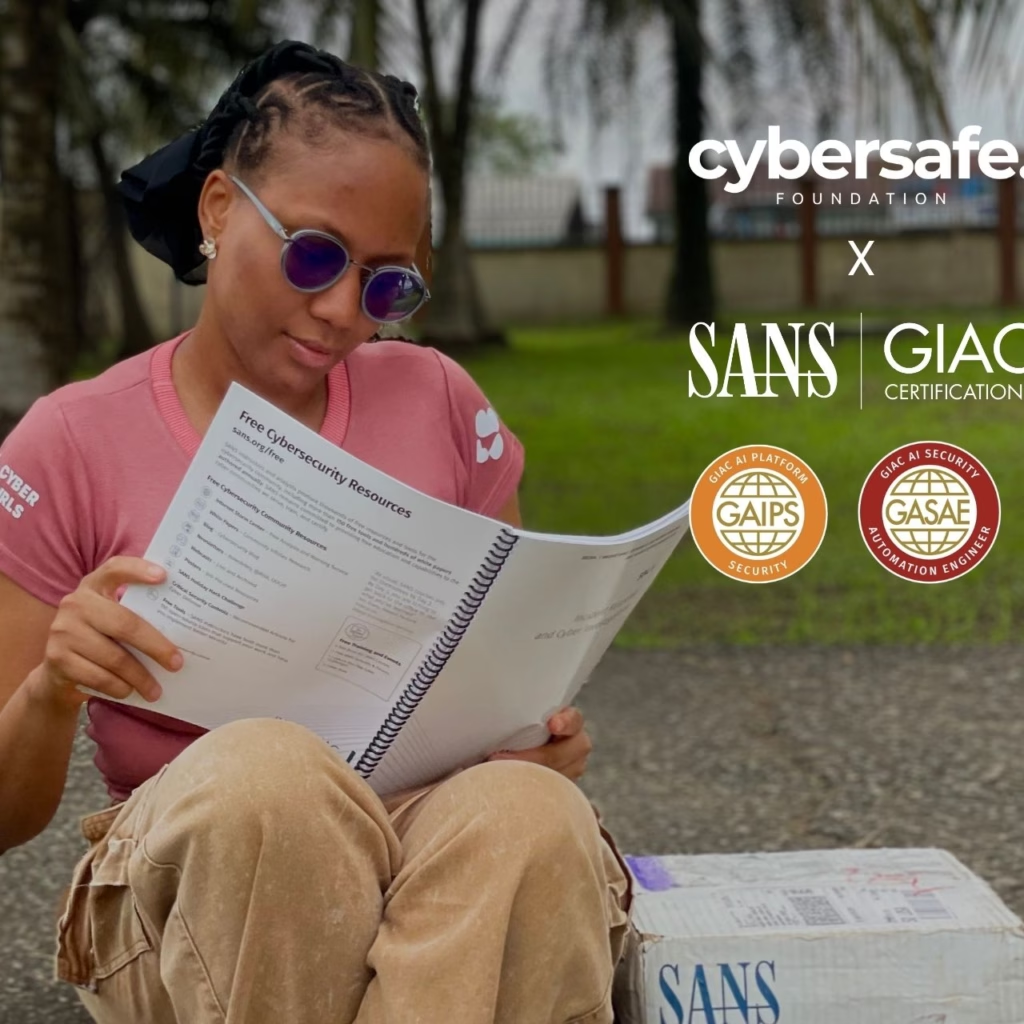
The CyberSafe X SANS AI Security Fellowship follows a carefully sequenced learning pathway, moving from AI security fundamentals to advanced application security and security automation.
01 — SEC411: AI Security Principles and Practices: GenAI and LLM Defense
Build foundational AI security knowledge, including how large language models work, tokenisation security, AI attack surfaces, prompt injection, and jailbreaking.
02 — SEC495: Leveraging LLMs: Building & Securing RAG, Contextual RAG and Agentic RAG
Build a Retrieval-Augmented Generation system from the ground up, self-hosted end to end, learning to implement access controls, defend against prompt injection, and protect sensitive information.
03 — SEC545: GenAI and LLM Application Security
Go deeper into securing real-world GenAI applications, including vector databases, LangChain agents, MCP, and Kubernetes, with AI threat modelling using the MAESTRO framework and a capstone capture-the-flag exercise.
04 — SEC598: AI and Security Automation for Red, Blue and Purple Teams
Automate security workflows through SOAR playbooks, infrastructure as code, and AI-driven detection and response across AWS and Azure.

This fellowship is designed for experienced cybersecurity professionals who are ready to specialise. You may be a strong fit if you can say yes to all of the following:
This fellowship is for you if you have already built cybersecurity experience and are asking what comes next: you want to understand the security implications of AI systems, gain practical exposure to emerging AI attack surfaces, and develop expertise that sets you apart in a fast-changing market.
| Miilestone | Date |
|---|---|
| Applications open | August 19, 2026, 12:00 PM WAT |
| Applications close | September 10, 2026, 12:00 PM WAT |
| Applications reviewed | Rolling basis |
| Selection and feedback | September 30, 2026 |
| Orientation | October 21, 2026 |
| Training begins | October 26, 2026 |
| Fellowship completion | July 30, 2027 |
Yes. The fellowship is fully funded. SANS provides the training and certification pathway as an in-kind contribution, and fellows do not pay tuition.
Women older than 21 who are African, English-speaking, resident in an African country, and have at least three years of hands-on cybersecurity experience.
No prior AI experience is required. Applicants do need a strong cybersecurity foundation, with at least three years of hands-on experience.
No. The fellowship is open to any African woman resident in Africa who meets the stated criteria, not only CyberSafe Foundation alumnae.
The pathway includes preparation for the GIAC AI Platform Security (GAIPS) and GIAC AI Security Automation Engineer (GASAE) certifications.
Training is delivered through SANS OnDemand: self-paced and online, with hands-on labs in every course, released in sequence rather than all at once, and supported by biweekly progress reviews.
Yes. Applicants must complete the designated prerequisite AI security course and submit the required credential before their application proceeds to formal review.
Applications are reviewed on a rolling basis. Eligible applicants move through the prerequisite requirement, shortlisting, interviews, identity verification, and final selection.
No. Applicants must be African and currently resident in an African country.
Your contact and location information, LinkedIn profile, current role and organisation, years of cybersecurity experience, a CV of no more than two pages in PDF format, and responses to the application questions. Additional AI-related articles or publications are optional.
Adding {{itemName}} to cart
Added {{itemName}} to cart